China’s New AI Robots Just Broke The Human Skill Barrier: A Revolution in Humanoid Robotics
- Athletic Feats and Precision: Machines Faster Than Olympic Champions
- Scaling Production: How China is Building an Army of 10,000 Robots Annually
- Control Innovations: From Brain Signals to Lab-Grown Muscles
- Implementation Challenges and Real-World Safety
- Sustainability and the Future: Fully Biodegradable Robots
Recent weeks in the world of robotics have brought breakthroughs that only a few years ago seemed confined to the pages of science fiction. We are witnessing a moment where machines are ceasing to be merely slow automatons performing repetitive tasks and are becoming dynamic units capable of competing with humans in disciplines requiring the highest physical fitness and coordination. AI w Biznesie, tracking the latest trends in automation, sees these events as the foundation for the upcoming industrial and service transformation.
Athletic Feats and Precision: Machines Faster Than Olympic Champions
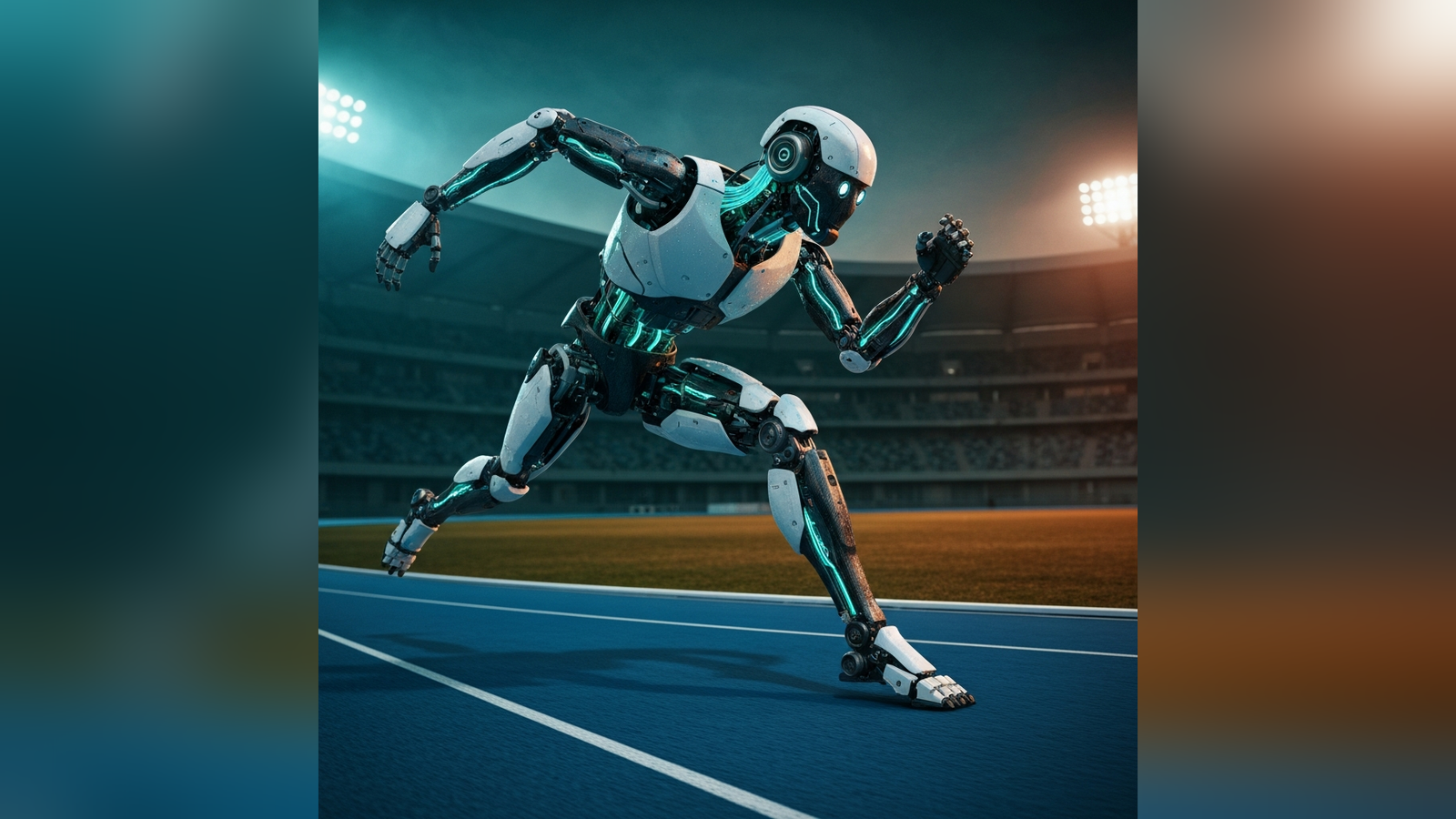
One of the most spectacular achievements of recent months is the progress in bipedal running. Chinese companies, such as Unitree, have challenged human speed records. The company’s founder, Wong Shing, openly declares that humanoid robots are on a direct path to breaking Usain Bolt’s record. A robot named Bolt, developed by Jang University and Jingshi Technology, already reaches a speed of 10 meters per second. For comparison, the average speed of the world record holder over 100 meters is approximately 10.44 m/s. This means that the 10-second barrier in the 100-meter sprint could be broken by a machine before the end of 2026.
Tennis and Reinforcement Learning
Precision is the second pillar of this revolution. The Leighton system, developed in collaboration with Galbat, has proven that robots can master sports disciplines requiring lightning-fast reactions, such as tennis. Using imperfect movement data from amateurs, researchers taught the Unitree G1 robot to perform forehands, backhands, and complex lateral steps. The results are astounding: in 10,000 trials, the robot achieved a success rate of 96.5%, maintaining rallies with humans from both the baseline and the net. The key to success was the application of deep reinforcement learning in massive simulations, allowing the machine to seamlessly combine movements in a natural way.
The Korean Response: Humanoid V0.7
China is not the only player pushing boundaries. The Korea Institute of Science and Technology (KIST) presented the V0.7 model, which stands out for its extraordinary athleticism. This robot not only runs at a speed of 12 km/h but can also play soccer, jump, and perform complex dance figures like the moonwalk. Significantly, the research team independently designed all key components, including the motors and 3K planetary gears, allowing for full control over the system’s dynamics. This „full-stack” approach to hardware construction is becoming the new industry standard, moving beyond the simple assembly of off-the-shelf components.
Scaling Production: How China is Building an Army of 10,000 Robots Annually
Transitioning from impressive video demonstrations to mass production is the biggest challenge currently facing the industry. UBTech from Shenzhen has taken a milestone step in this direction by signing a strategic agreement with the giant Siemens. The goal is to create a digital backbone for the factories of the future, which will be capable of producing 10,000 humanoid units annually by 2026. This collaboration covers full product lifecycle management – from design and simulation to production process planning.
Economies of Scale and Market Dominance
China currently controls a significant portion of the robotics component supply chain. They hold about 70% of the global lidar market and a dominant position in the production of harmonic reducers. As a result, production costs are dropping drastically. For example, entry-level home robots like the Noetix Bumi are entering the market at prices hovering around 1,400 USD. In 2025, China installed over 80% of all new humanoid robots worldwide, demonstrating the scale of their determination to dominate this sector. AI w Biznesie points out that such a concentration of resources and production will allow for the rapid implementation of automation in the logistics and healthcare sectors.
The Walker S2 Model and Autonomous Factories
Further evidence of technological maturity is the Walker S2 model, designed for industrial work. This robot features an autonomous battery replacement function – when the energy level drops, the machine independently goes to a docking station, replaces the power module, and immediately returns to its tasks. Such solutions eliminate downtime, which until now has been a major barrier to the full automation of assembly lines. Orders for these units in 2025 exceeded 1.4 billion yuan, confirming immense market demand.
Control Innovations: From Brain Signals to Lab-Grown Muscles
Parallel to the development of mechanics, a race is underway in the field of new control methods and machine interaction. Researchers at Oklahoma State University are working on a neuroadaptive control system that allows robots to read human brain signals. Using EEG caps, the system detects so-called error-related potentials (ErrP). These are signals generated by the brain when a person notices something is going wrong – often before they even have time to physically react. This allows the robot to stop or correct its action within milliseconds, which is crucial in dangerous environments such as nuclear waste disposal or deep-sea inspections.
Bio-hybrids: The Ostrobot
An extremely fascinating direction is the use of living tissue in robotics. Researchers from the National University of Singapore created the Ostrobot – a fish-inspired robot powered by lab-grown muscles. The innovation lies in the fact that the muscle tissues are connected in a way that forces them to „self-train” during development. Thanks to this, the Ostrobot reached a speed of 467 mm per minute, a record for robots powered by skeletal muscles. This system can be controlled using electrical pulses or even sound signals, such as a clap.
Grip and Manipulation: The DG5FS Hand
One of the most difficult elements to replicate is the human hand. The Korean company Tasalo presented the compact, five-fingered DG5FS hand, which has 20 degrees of freedom and weighs only 880 grams. It utilizes „back-drivable” joints, allowing for safe interaction with the environment and shock absorption. Simultaneously, Samsung is building its own hand laboratory, focusing on tendon-driven actuators and tactile sensors that will allow robots to feel texture, pressure, and minor object slips, mimicking human precision. The market for such advanced grippers is expected to reach nearly 900 million dollars by 2030.
Implementation Challenges and Real-World Safety
Despite spectacular successes, reality can brutally verify the capabilities of machines. An incident at a Heidiow restaurant in Cupertino became a loud warning. The AgiBot X2 service robot, while performing an entertainment dance for guests, got too close to a table and knocked over dishes, causing chaos. Although the company explained that the robot was moved closer to the table at a guest’s request, which limited its maneuvering space, the situation exposed a key problem: generalization. Robots perform perfectly in controlled laboratory conditions, but in an unpredictable environment full of people and moving obstacles, they can still pose a threat.
The Problem of the „Unpredictable World”
Experts from AI w Biznesie emphasize that the most difficult barrier for Embodied AI is the ability to handle situations that were not in the training data. Even the fastest robots, like the aforementioned Bolt, may have trouble maintaining balance on a slippery surface or in a crowd. This is why work on systems like Doflow, which allow robots to learn tasks directly from human demonstrations, is so important, as it increases their flexibility in action.
Wanderbot and Battery-Free Exploration
An interesting solution to power problems in difficult terrain is the Wanderbot project from Cranfield University. This is a wind-powered robot using a Savonius turbine and a Jansen walking mechanism. Since movement in robotic systems consumes about 20% of battery energy, eliminating this load allows for long-term missions in extreme conditions such as deserts or other planets. The structure is fully 3D printed, enabling easy on-site repair – a key feature in space logistics and polar research.
Sustainability and the Future: Fully Biodegradable Robots
With the vision of millions of robots entering factories and homes, the question of the technology’s environmental impact arises. The answer to this challenge is a joint project by researchers from Korea and Austria, who developed the first fully compostable soft robot. Its frame is made of biodegradable PGS elastomer, which maintains durability for over a million work cycles and then decomposes in the soil within a few months without leaving toxic waste.
Eco-friendly Electronics
Most breakthrough of all, this robot contains no traditional metals or semiconductors. It uses biodegradable inorganic electronics that decompose along with the support structure. Despite its „eco-friendliness,” the machine features sensors for temperature, humidity, pH, and modules for drug delivery. This shows that caring for the planet does not have to mean giving up advanced functions. At AI w Biznesie, we believe that such an approach will be the foundation of ethical automation in the coming decade.
Summary: A New Era of Collaboration
Chinese dominance in production, Korean innovations in mechanics, and the global race to create the most dexterous robotic hand point to one thing: the human skill barrier has been broken. Robots are becoming faster, stronger, and increasingly autonomous. For entrepreneurs, this means the necessity to adapt to a new reality where automation is no longer a choice, but a condition for survival. The future belongs to systems that can seamlessly merge with human intelligence, providing support where human limitations become a barrier to development.

No responses yet