Why second brain AI systems have a problem
Many companies use second brain AI systems. These systems store knowledge. Everyone builds them their own way. There is no single method. This creates chaos. New workers waste time learning the structure. The AI agent makes mistakes. It puts files in wrong places. It creates duplicates. It does not know the data already exists.
Here is a real-life example. The company AI w Biznesie uses its own second brain. It stores strategies and instructions there. It uses Git and GitHub for version control. Every team member has access. A new worker downloads the base and knows the context right away. The Claude.md file guides the agent. But the agent still makes errors often. It searches for each file by hand. It uses many tokens. This costs time and money.
The problem is the lack of a standard. Every second brain is different. The agent does not know where to look. It searches by keywords. In deep folders, it needs many tries. This does not work well for large bases. The solution must be simple and repeatable. Google understood this. It is introducing a new format.
Open Knowledge Format – a new way for standards
Google released Open Knowledge Format. It is a standard for knowledge bases. With it, every agent and human understands the structure. Knowledge becomes portable. You can share it between companies. This is similar to earlier standards. MCP made agent talks with outside tools uniform. Skills made repeatable instructions uniform. Now it is knowledge’s turn.
The format is based on the idea from Andrej Karpathy. It is the LLM Wiki Pattern. Before this, people used RAG. RAG turns documents into vectors. Vectors help models understand meaning. But Karpathy saw a flaw. The agent builds the answer from scratch each time. It does not learn over time. Markdown files let the agent gather context. This gives better results.
The problem was no uniformity. Everyone made their own version. A new person had to explore folders. OKF changes this. It gives a rigid template. Every file also has a YAML header. It describes what is inside. The agent reads the header first. It decides whether to open the file. This saves time and tokens.
How OKF is different from RAG
RAG stores knowledge in vectors. The agent does not see the structure. It only sees meaning. OKF uses files and folders. The agent sees the physical layout. It can navigate like a human. This works well with small changes. Adding a new file does not need full processing. You just put it in the right folder.
RAG needs constant indexing. Every change costs money. OKF is lighter. The agent uses the file system. Models already have an inbuilt skill for navigation. This is a natural path. Google is going with the times. It wants agent search engines to work faster. Maybe OKF will also be used on websites. Similar to how the LLMs.txt file is used now.
How Open Knowledge Format works under the hood
The OKF system splits knowledge into concepts. Each concept is one topic. For example, data about a client or a procedure. Concepts sit in folders. The folder is named after the topic. Inside is only that one topic. This is the rule of minimalism. The agent does not mix information.
The index.md file is important. It sits in every folder. The agent reads it first. It gives a list of things in the folder. Every document has a YAML header. It has a name and a description. The agent decides fast. It does not have to open all files. It loads only what it needs. This cuts down token use.
An example OKF structure
Imagine a folder about marketing strategies. In it, the index.md file describes the strategies. There are three documents: SEO, social media, and content. Each one has a YAML header. The agent looks for SEO information. It reads the index.md. It sees the header of the SEO document. It opens that one. It does not open the others. This saves time and tokens.
This system is simple for humans. A new worker sees the list in the index.md file. They know where to look. The agent has the same map. It does not make mistakes. This is important for large bases. The company AI w Biznesie tested this in practice. They changed their second brain to OKF. They saw a big improvement.
Testing OKF on a real second brain
AI w Biznesie already had its own second brain. They used it every day. They decided to test OKF. They did not want to take risks. They made a new branch in Git. That is a copy of the project. The changes did not affect the main system. This is a safe approach.
OKF has three tools. First, the enrichment agent. It works with Google’s BigQuery. AI w Biznesie does not use BigQuery. So they made their own skill. They called it markdown to OKF. It changes Markdown files into OKF format. It uses scripts. The code does most of the work. The agent only checks the quality. This script-first way cuts token use.
The skill also has evaluations. These are tests to check the change is correct. The agent runs the tests after every change. This gives certainty. AI w Biznesie used this skill. They moved their whole second brain to OKF. Every folder got an index.md file. The agent knew the structure right away.
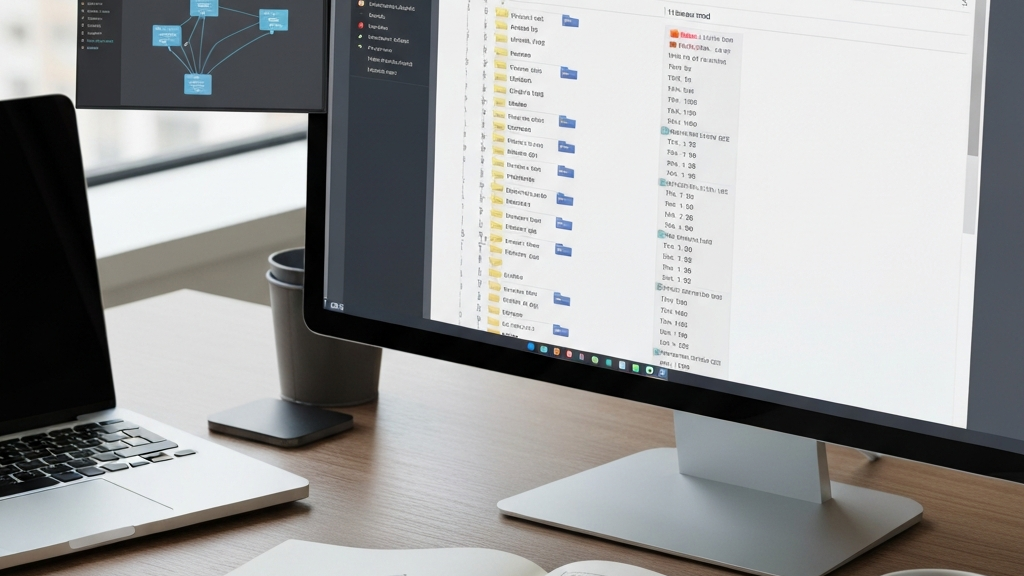
Then they ran the visualization. The terminal command was visualize. It made an HTML page. It shows a graph of connections. Files link to each other like in Obsidian. This helps to understand relationships. A new worker sees everything in one picture. They learn the system fast.
Test results: faster and cheaper
At first, the agent searched the old way. It used pattern matching. It was slow. Then they added instructions to Claude.md. They described the OKF structure. The agent started using index.md. It searched through YAML headers. Search times dropped by half. Tokens also went down. The agent knew what was in the files. It did not open unnecessary ones.
Mistakes disappeared. The agent did not put files in wrong places. The system is predictable. This is important for companies with a lot of knowledge. AI w Biznesie recommends everyone try OKF. Even if it is not yet an official standard. Early adoption gives an edge. Google may soon add it to search engines. Then OKF will become common.
What this means for your company
OKF does not need new tools. You make folders and Markdown files. You add index.md to each folder. YAML headers describe the content. The agent adapts on its own. You can start with a small project. Test it on one department. Then grow it to the whole company.
The benefits are clear. Fast searching. Fewer mistakes. Lower token costs. Knowledge becomes portable. New workers learn faster. You can share the base with partners. This builds trust. AI w Biznesie already sees better performance. They recommend OKF as a simple standard.
The future is agent-style search engines. Websites can add OKF. Instead of just an LLMs.txt file. The agent will find information faster. Google may support this. It is good to start now. Standardizing knowledge is the next step in automation. Do not wait until the standard is forced on you. Bring it in yourself.
Remember the rule of minimalism. Each concept is one thing. Do not mix topics. Use short folder names. Check index.md often. This is the key to success. The company AI w Biznesie helps with setup. They offer scripts and templates. You can find them in their community AI Labs Pro. It is a place for those who want to make AI work better.

No responses yet