What is GLM-5.2 and why are we talking about it?
GLM-5.2 is a new artificial intelligence model. It was made by the company Z.ai. This model will be available as open source next week. Open source means anyone can download and use it. The MIT license allows commercial use without extra fees.
The model has a very large context window – up to 1 million tokens. Tokens are pieces of text. For comparison, other models usually have 100,000 to 200,000 tokens. This means GLM-5.2 can look at very long documents or whole coding projects at once.
The team at AI w Biznesie believes this is a big step forward. A long context helps with task automation. For example, you can load a company’s full rulebook and ask a question. The model finds the answer without splitting the text into parts.
What makes GLM-5.2 special?
Another important thing is the way it thinks. The model has two thinking modes: High and Max. High mode is faster. Max mode gives more accurate answers. The user chooses which one they need. This is simple and handy.
The model uses a Mixture-of-Experts design. It has about 750 billion parameters. Parameters are weights that the model learns. But not all of them are used at the same time. This saves computing power and speeds up work.
Why is the open source license important?
Many strong models today are closed or have strict rules. Open source under MIT license changes that. Companies can use GLM-5.2 without asking for permission. They can also change it to fit their needs. This encourages more people to try and adopt AI.
At AI w Biznesie, we see this as a chance for small and big businesses. You do not need a big budget to test a powerful model. You just download it and start working. This lowers the barrier for entry into AI.
How does GLM-5.2 work in practice?
To see if GLM-5.2 is really good, people tested it on real tasks. One YouTuber tried it on ten different coding jobs. Most of them ended well. The model built games, websites, and 3D models from scratch.
The model often did not get everything right on the first try. But it was very good at fixing its own mistakes. When the tester gave feedback, the model improved the code. This is a big plus for real work.
Test of games and apps
In one test, the model made a rally game in the C++ language. The game ran very smoothly. The tester said it was one of the best results he had ever seen. He also made a skateboard riding simulator. It was good but missing colors on the board.
Another test was a website for a watch brand. The model had to create a 3D watch model. The first try was poor. The tester criticized it. On the second try, the model made a much better watch. You could see the hands, and even the second hand moved.
Test of 3D modeling
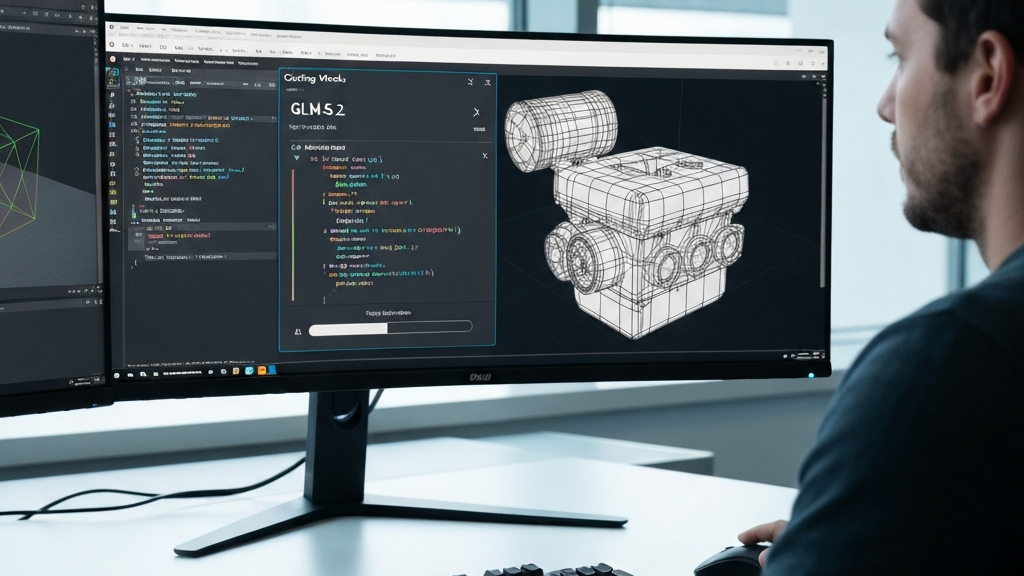
The most impressive test was a V8 engine model. The model created an STL file for 3D printing. An STL file contains a geometric shape. The model even added instructions on how to print the engine. It said to place it on a flat surface and use supports. Very practical.
AI w Biznesie sees a lot of potential here. Automating the creation of 3D models can help in design work. Instead of drawing by hand, you just describe with words. The model does the rest. This saves time and effort.
Strong points of GLM-5.2
The main advantage is the long context of 1 million tokens. This allows working on entire projects. Programmers can load a whole code repository. The model understands how files depend on each other.
Another strong point is fixing errors step by step. The model checks its own code. If it finds a mistake, it tries to correct it. The tester noticed that the model often improved code after criticism. This is like a barber who checks every hair after cutting.
The MIT license is also a big plus. Companies can use the model without limits. They do not have to pay or ask for permission. This invites experimentation and deployment.
Performance compared to other models
The tester compared GLM-5.2 with a model called Fable. Fable was closed and very expensive. GLM-5.2 is open source. The results were similar in many tests. In some areas, GLM-5.2 was even better. This is a big success for open models.
In a Python coding test, the model made a drum machine simulator. It worked correctly. The tester liked the visual effects. Even with small errors, the overall score was high. This shows that GLM-5.2 can compete with paid models.
Long context in real use
Let’s look at a real example. A team at AI w Biznesie tried to load a 500-page software manual. The model read everything in one go. Then it answered questions about specific functions. No need to search through pages. This makes work faster and easier.
Another example is analyzing a whole set of legal contracts. The model checks for conflicts. It can find clauses that do not match. Doing this by hand would take days. With GLM-5.2, it takes minutes.
Weak points and limitations
Not every test went well. The 3D printer simulator did not work. The plastic did not appear on the screen. The model tried to fix the bug three times. Sadly, no success. This shows that the model does not always solve simple problems.
Another issue is the lack of benchmarks at launch. Benchmarks are standard tests to compare models. The company did not show results on known data sets. The community has to test the model themselves. This can delay decisions about using it.
At the start, only paid users of the Coding Plan could test the model. This may disappoint people who want to check it right away. The company promised public access within a week. But until then, early access is limited.
Problems with rendering and geometry
In game tests, there were errors in shapes. For example, the car looked wrong. Or the track was in the wrong place. The model did not understand some directions. This is a problem that other models also have.
The tester noted that the model often needs a second try. The first result can be weak. But after criticism, the model improves. This means you must be patient. You will not always get a perfect result on the first attempt.
Room for improvement
The model still has gaps in reasoning. For example, when asked to print a 3D object, it forgot about support structures on some tasks. Users must check the output carefully. Relying on it blindly can lead to mistakes.
Also, the model’s strength in coding does not always transfer to other areas. In general knowledge questions, it may not be as strong as some closed models. But for coding and agent tasks, it is very good.
Summary – is GLM-5.2 worth your attention?
GLM-5.2 is definitely one of the best open models for coding. The long context and MIT license are huge advantages. The model does well at creating apps and 3D models. AI w Biznesie recommends testing it in automation projects.
But it is not perfect. It has trouble with simple tasks and needs iterative fixes. There are also no independent benchmarks yet. This means we cannot call it the absolute best. But it is a very strong contender.
For programmers and companies, this is good news. An open model with such abilities is rare. It is worth following more tests and official results. The coming weeks will show if the model keeps its promises. For now, it looks promising. The competition should watch out.
At AI w Biznesie, we plan to use GLM-5.2 in our client projects. We already see how it can speed up code generation and document analysis. If you want to try it, you can download the open weights soon. Start with simple tasks to see its potential.
The world of open source AI is moving fast. GLM-5.2 is a clear signal that free models can be powerful. They can compete with expensive, closed ones. This is good for everyone. More choice means better technology for all.

No responses yet