New Atlas Can Now Really Work
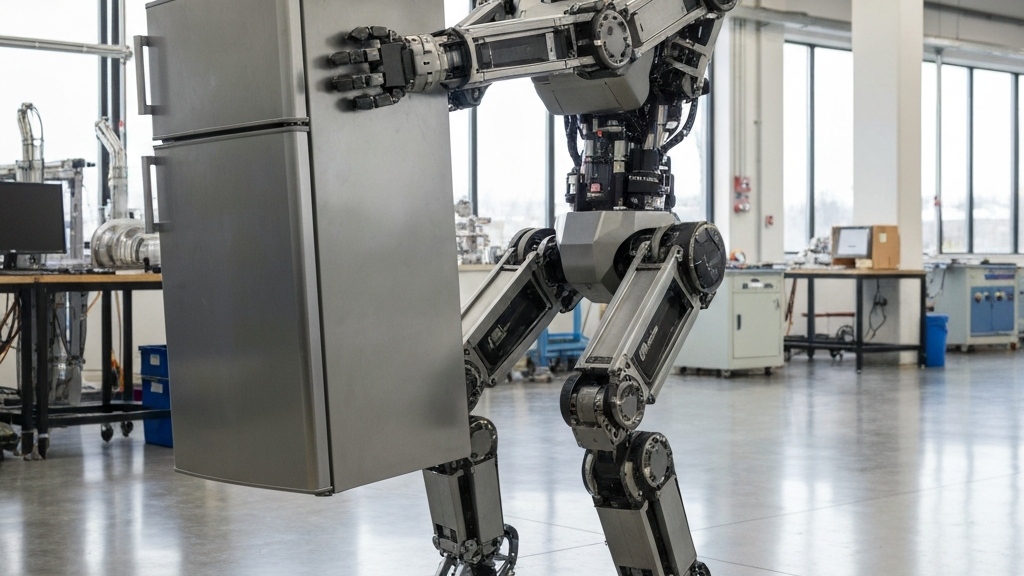
Boston Dynamics showed a big update of their robot Atlas. Now the machine can lift a heavy fridge and carry it across the lab. This is not just a show of acrobatics anymore.
The robot uses its whole body to keep balance. It turns its torso, bends its legs, and adjusts its grip to the weight. This shows that Atlas is learning to handle real tasks.
The team at AI w Biznesie knows how important it is to connect new tech with real use. That is what Boston Dynamics is doing now. Atlas is no longer a showpiece but a tool for work.
The Mini Fridge Test Is a Big Challenge
At first, lifting a fridge may look easy. But inside there were random objects from the lab. Their weight could move during the motion.
The robot had to handle an unstable load. Atlas not only looked at the fridge, but also felt how its weight changed. This is called proprioception — the sense of one’s own body position.
Why This Matters in Practice
In a factory, objects do not always stand still. The floor has different friction, and the load can tilt. The robot must react to these changes without human help.
Boston Dynamics says Atlas trained on loads from 23 to 32 kilograms. In the real test, it carried a fridge over 45 kilograms. That is a big jump in ability.
Training Methods Are Like Training an Athlete
The company used reinforcement learning — a method of rewards for correct actions. Atlas did the same task millions of times in a computer simulation.
Engineers changed training conditions: fridge weight, floor friction, and grip strength. This way, the robot learned to survive in many situations. It is like an athlete training on different fields.
Then they moved the learned behavior to the real robot. This is called the sim-to-real gap. Boston Dynamics says the new Atlas has a very small gap.
What Changed in the Design
The new Atlas has a simpler build than older versions. Both arms are the same and both legs too. This helps with production and repairs.
The robot has no cables running through its joints. So it can turn its torso without any limits. Even the feet are symmetric so Atlas can walk forward and backward equally well.
Parts of the robot can be replaced in a few minutes. That is important if the machine must work in a factory without long stops. The team at AI w Biznesie knows that fast service is key for real use.
Hyundai Plans to Produce Thousands of Robots
Hyundai, owner of Boston Dynamics, has big plans. The company wants to make 30,000 Atlas robots each year by 2028. The machines will go to car factories in the United States.
The first rollout is planned for 2028 in Georgia. Robots will help with sorting parts and later with assembly. This is not an experiment anymore but a concrete industrial plan.
Hyundai also makes 300,000 drive units each year. These are like muscles for robots. This way Atlas can be built in large numbers and at lower cost.
Other Companies Are Also Speeding Up
Unitree showed the G1 robot that responds to voice commands. You can tell it what to do, and it generates movement in real time. That is a step toward natural control.
Gatsby takes a different path. The company offers home cleaning by a humanoid for $150 per visit. You do not need to buy the robot, just order the service like a taxi.
Gatsby is not tied to one maker. If a better model appears, the company will just use it. This is a flexible approach to the service market.
What This Means for the Future of Robots
All these examples show one direction. Humanoids are moving from flashy videos to real work. First they learned to walk, then to jump, and now to carry heavy objects.
Factories and warehouses are the natural first market. The environment can be better controlled, and tasks are repeatable. In a home, the robot must handle unpredictability.
Boston Dynamics showed that Atlas has physical IQ — the intelligence of the whole body. The robot not only sees the object but also feels how it affects its balance. That is key for work in the real world.
The team at AI w Biznesie helps companies adopt similar solutions. Automation with robots can increase efficiency and safety. It is worth watching how this technology grows.
The new Atlas is a clear sign that the era of practical humanoids is just beginning. It is no longer about special effects but about machines that truly help with work.

No responses yet