What Can the New Atlas Do?
Boston Dynamics showed a new version of its robot Atlas. This is an important moment for the whole robot industry. The robot can now lift heavy objects and carry them to another place.
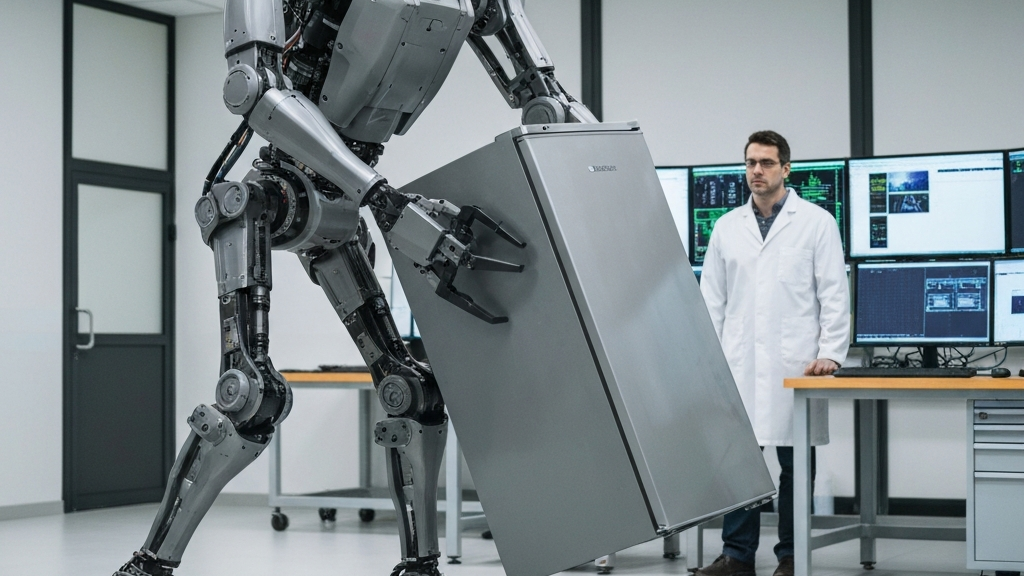
In the new video, we see Atlas lift a loaded mini-fridge. The robot turns its body 180 degrees and squats to grab the load. Then it carries the fridge across the lab and hands it to an engineer.
The fridge weighed over 45 kilograms. Inside there were different items, so the weight shifted. This made the task much harder than lifting a normal box.
Boston Dynamics wants to show not just strength. The company shows that the robot can use its whole body to work. This is a big step toward practical use in warehouses and factories.
The team at AI w Biznesie says such skills are important for businesses. A robot that can handle heavy and unpredictable loads can help in many tasks. For example, in warehouses where goods have different shapes and weights.
Why Full-Body Control Matters
When a person lifts something heavy, they do not use only their arms. We bend our body, tighten our legs, and adjust our grip. Our whole body works together to keep balance.
Atlas does the same. The robot feels how the load affects its body. It can change the position of its legs and arms to avoid dropping the item. This gives it an advantage over simpler robots that only repeat saved moves.
AI w Biznesie offers solutions to help companies use such robots. For instance, we help plan how to add robots to current workflows. This makes the change smoother and faster.
How Did Atlas Learn New Moves?
Training Atlas is a complex process. Boston Dynamics used reinforcement learning and simulations. The robot practiced millions of times in a virtual world before getting new tasks.
First, engineers made a simple movement pattern. Then the robot practiced it in the simulation. The system rewarded correct actions and punished mistakes. This way, Atlas learned the best way to lift the fridge.
During training, many things changed. The weight of the fridge, the floor friction, and the grip strength. The robot had to learn to handle different situations. This makes its behavior more resistant to problems in the real world.
Small Gap Between Simulation and Reality
Boston Dynamics talks about something called the sim-to-real gap. This is the difference between how a robot works in simulation and how it works in the real world. Many companies have this problem. Their robots work great in a computer but poorly in a factory.
Atlas has a very small gap. This is because the robot’s design is simple and easy to copy. Parts repeat, and motors are simple. As a result, what the robot learns in simulation also works in reality.
This is a big advantage over competitors. Many firms fight this problem for years. Boston Dynamics shows that good design from the start can solve it.
What Changed in Atlas’s Design?
The new Atlas has many improvements in its build. The company simplified the design and removed unnecessary parts. This makes the robot cheaper and easier to produce.
Both arms of the robot are the same. Both legs are also the same. This makes production and repairs easier. When one part breaks, you can quickly replace it with a new one. Engineers can do this in a few minutes.
There are no cables in the joints. This allows the robot to fully rotate its body. Atlas can move in ways that are impossible for a human. This gives it an advantage in tight spaces.
The robot’s feet are symmetric. Atlas can walk forward and backward with equal ease. This is important in places where you need to change direction often.
Why Do Acrobatics Matter?
Many people think flips and handstands are just tricks. But these moves teach the robot important skills. Balance, strength, and body control in difficult situations.
When a 90-kilogram robot does a handstand, its motors and cooling must be very strong. The same endurance helps in hot factories. The robot does not overheat and can work longer.
Boston Dynamics says these skills help in daily work. The robot handles slips and uneven surfaces better. This makes it more useful in real plants.
What Does Atlas Mean for Industry?
Hyundai, which owns Boston Dynamics, has big plans. They want to place Atlases in their factories in the USA. People talk about 25,000 robots over a few years.
Production should start in 2028 in Georgia. First in a Hyundai factory, then in Kia plants. This is not a small test, but a serious entry of humanoids into industry.
Each robot will cost less than older models. Thanks to the simpler design and repeating parts, production is cheaper. The company wants to make 30,000 robots per year by 2028.
AI w Biznesie believes this is a good direction. Humanoid robots are ideal for factories because the infrastructure is already made for people. You do not need to rebuild the whole plant for the robot to work.
Where Will Robots Go First?
According to experts, factories will be first. The work there is repetitive and the environment is predictable. A robot can quickly learn tasks on the production line.
Then warehouses will come. There is also much repetitive work, but more chaos. The robot must handle different items and changing conditions. This is harder, but still possible.
Homes will be last. In a home, everything is different every day. The robot must understand hundreds of small exceptions. For now, this is too hard for today’s machines. But companies like Gatsby are testing such services.
Competition and the Future of Humanoids
Boston Dynamics is not the only company in this field. Unitree showed its robot G1, which responds to voice commands. This is a step toward more natural control.
The robot hears a command and generates movement in real time. This is harder than it sounds. Simple speech recognition is a small problem. The real challenge is linking sound to physical movement of the whole body.
Gatsby takes a different path. The company does not build a robot, but a cleaning service. For 150 dollars, a humanoid comes to a home and cleans the apartment. This is a model like Uber, but for robots.
Gatsby can change robots based on need. If a better machine appears, the company will switch to it. This is a clever approach that does not rely on one piece of equipment.
When Will Humanoids Become Common?
Experts say 3 to 5 years for the first big uses in factories. Then comes time for warehouses and logistics. Homes may wait another 10 years or more.
Technology moves fast. Each new video from Boston Dynamics shows progress. Robots become stronger, faster, and smarter. But they still lack the flexibility of a human.
AI w Biznesie follows these changes closely. For clients, it is important to know when the technology will be ready for real uses. For now, robots work best in ordered industrial settings.
The new Atlas is a signal that humanoids are entering a new phase. It is no longer just about video effects, but about real work. A fridge carried across a lab is a small step, but an important one for the whole industry.

No responses yet